These days, having a social media account on Facebook, Instagram, or Twitter is a common strategy for most brands.

The popularity of social media with consumers is huge because it provides them with an opportunity to meet new people, share their experiences with others, and to stay in touch with friends. Businesses have also recently realized the power of social media as a marketing instrument.
Social networking services, especially Instagram, can be amazing platforms for letting consumers know a brand’s story in a creative and visually stunning way.
Furthermore, using social media for business purposes is associated with some substantial benefits, including gaining traffic, direct customer interaction, and increased sales.
Luxury companies are no exception to this rule as many luxury brands now have social media accounts on the majority of the most popular social networking services.
Although luxury brands are quickly adapting to the social media world, marketing mistakes, which result in gaffes and blunders, are inevitable.
Here are five interesting cases when social media marketing of luxury brands went wrong on social media.
1. Dolce & Gabbana
While D&G remains one of the most respected luxury fashion brands, the behaviour of its owners and co-founders is not always that admirable. Stefano Gabbana is infamous for his controversial comments on social media and particularly on Instagram.
For example, Gabbana called several respected style icons, such as Selena Gomez and Kate Moss ‘really ugly (opens in new tab)’ on Instagram.
And it does not seem Gabbana is learning his lessons.
In their Instagram account, Diet Prada posted several screenshots of a dialogue between Gabbana and Michaela Tranova. During the conversation, Gabbana ‘criticised’ China and its people.
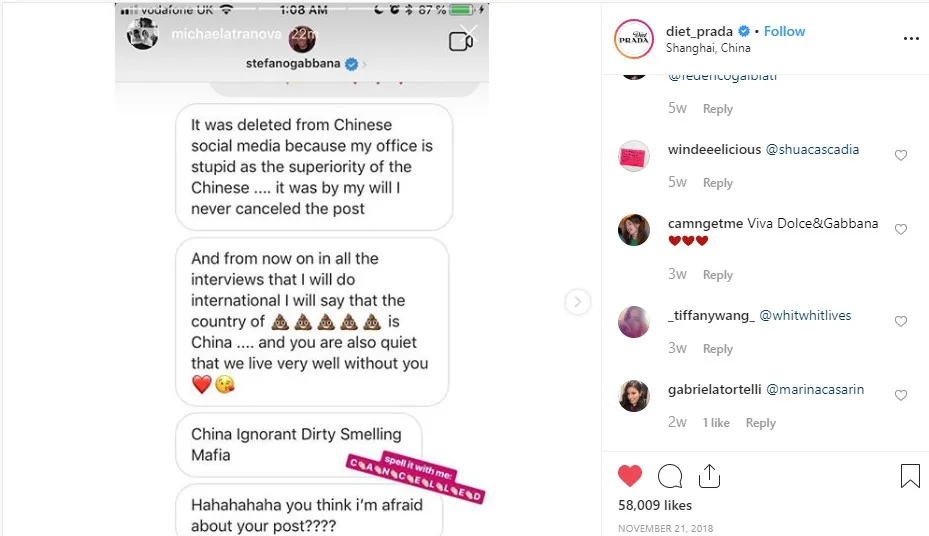
There is no surprise that this ignorance caused a wave of criticism and the backlash was immediate. As a result, the hashtag #BoycottDolce began to spread fast on social networking websites.
Although Gabbana has since sincerely apologized for his actions to the public, they produced a strong impact on D&G’s reputation and financial performance.
The company had to cancel its Shanghai runway show that cost it a fortune.
If I were Domenico Dolce, I would seriously reconsider my business partnership with Stefano Gabbana.
It is true, the man is a legend in the fashion industry. But his antics are counterproductive from the business perspective.
2. Saint Laurent
Provocation may not be the best way to promote goods on social media since it can evoke negative feelings and emotions and negatively affect the company’s credibility.
At the same time, Saint Laurent, a luxury fashion house, has a different opinion on this matter. In its effort to provoke consumers, the brand posted a ‘Porno Chic’ ad on its Instagram account featuring a young woman in high heels with spread legs.
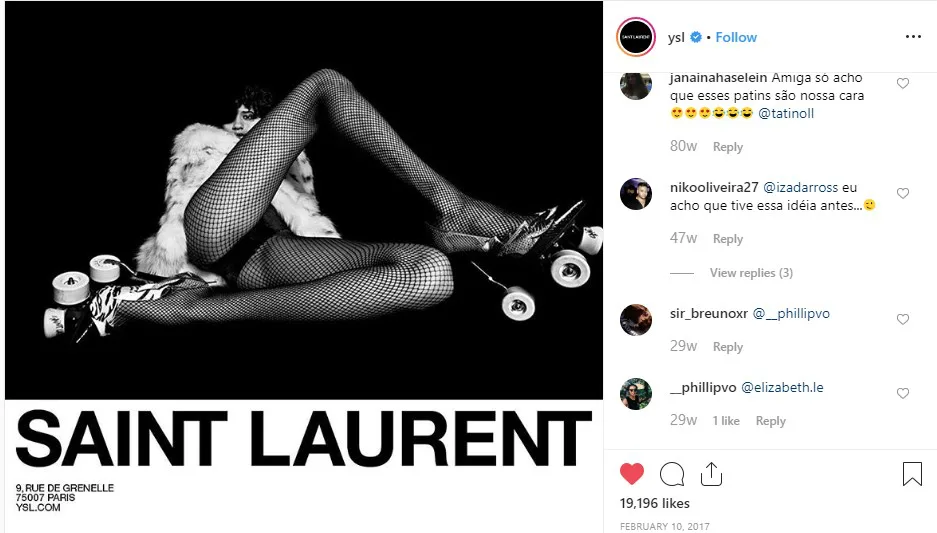
Posted just before International Women’s Day, this ad was expected to give us empowering images of women.
Instead, we got what we got.
In response to such a shocking advertisement, Autorité de Régulation Professionnelle de la Publicité, a France-based advertising watchdog, claimed that Saint Laurent’s campaign was not in keeping with the advertising codes in part of respect for dignity and decency.
But is the ad so sexist? One can argue that the image used by the fashion brand focuses on the femaleness of the model, which just captures the reality of what it is like to be a woman.
However, some fashion consumers did not view it like that. Regardless of the side that you choose on this matter, you can’t deny the effect this ad has produced.
We are talking about it right now, after all.
3. Z Palette
Z Palette’s Instagram campaign is another example of how you should not market your goods.
As a brand operating in the social media environment, you should understand that your message cannot be targeted to a single consumer group. Instead, merely every social media user can have a look at it and comment on what they like or dislike about it.
However, it seems that Z Palette ignored this axiom of the social media world. When the luxury brand launched an Instagram campaign to promote its lipstick depotter, some users complained that the price for this good was too exorbitant.
Well, charging $85 for a lipstick depotter is indeed a little too much. But Z Palette is a luxury brand after all, so what did these users expect?
Z Palette responded to these complaints in the worst way possible – by ‘bullying (opens in new tab)’ its customers.
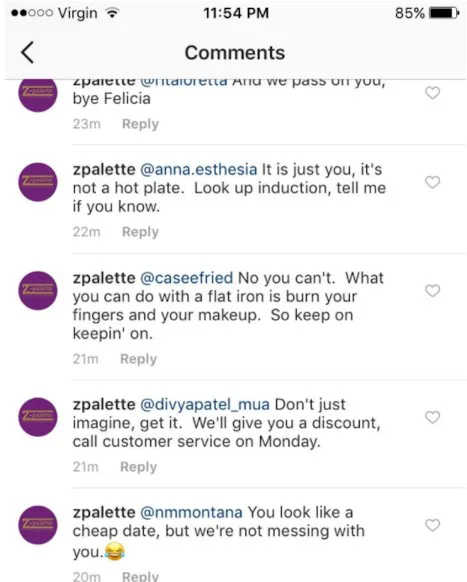
And of course, they were outraged and called other users on Instagram and Twitter to boycott the brand (opens in new tab). In the end, several websites that were selling Z Palette’s goods refused to partner with the brand.
Not the best result of a marketing campaign, I guess.
The brand tried to rectify the situation by stating that its account was hacked, but honestly, it was a poor excuse.
4. Audi
Sometimes companies try out something different from just posting beautiful photos and videos on their social media accounts to spark consumer interest. Sometimes this strategy works, sometimes it does not.
For Audi, this strategy was definitely a fail.
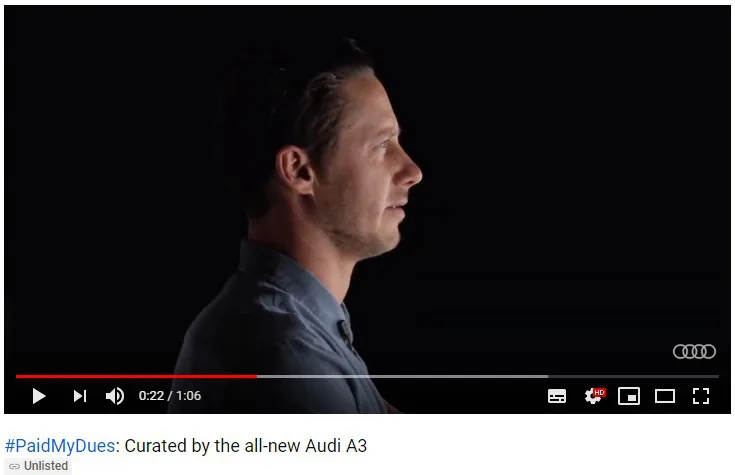
It all started when the brand decided to step aside from highlighting the beauty of its cars and aim at drivers instead (opens in new tab).
Audi’s intentions were noble as it tried to tell real-life stories of drivers, making the brand more ‘humanized’. But social media users did not get the idea.
Instead, the brand’s marketing campaign was perceived as a distraction from its main purpose, which is to make great cars.
After the campaign failed within the span of only two weeks, Audi returned to highlighting the beauty of its cars on Instagram.
5. Chanel
One can argue that social media is a synonym of mass media, while luxury brands focus only on a small consumer group.
This argument definitely has its point since, in the marketing terms, social media gives access to the mass consumer. Instead, only a few can afford luxury goods.
So luxury companies do not rely on social media when it comes to promoting their products. However, if a company decides to create an account on a social networking service, it should definitely invest financial and human resources in marketing to improve its social media presence.
And if this decision has been made, you should not be lazy like Chanel.
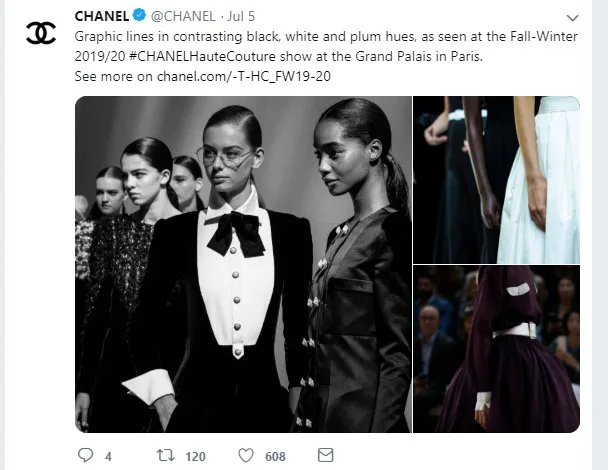
The brand’s content on Twitter is very repetitive and there is nothing engaging in this approach. Sharing the same pictures and videos over and over again does not seem like a good idea to many consumers, myself included.
It can even be considered as disrespectful by some Chanel customers, which is not beneficial to its brand image or reputation.
Why should users spend their time on these repetitive posts in the first place? Chanel should ask itself this question and change its social media strategy for good.
Luxury brands should have a clear understanding of social media and its philosophy in order to get the most from the platform. It is apparently not enough to just post photos and videos on social networking services.
Like any other type of good marketing, the success of luxury brands on social media boils down to understanding consumer behavior and providing users with what they desire.
Mastering social media marketing can be a steep learning curve, but in the end, the time taken to learn what makes consumers tick, who they follow, and how they relax online will help you consider what social networking platforms suit your brand.
While some mistakes can still happen along the way, it is always better to learn from the mistakes of others.
In this article, we have summarized the most outrageous and scandalous social media failures that hopefully will help some brands produce content that appeals to consumers through social media.